Classic SKYJO · Expansion guide · October 25, 2026
SKYJO Expansion 2026: The 14 New Cards, Rules, and Action Differences
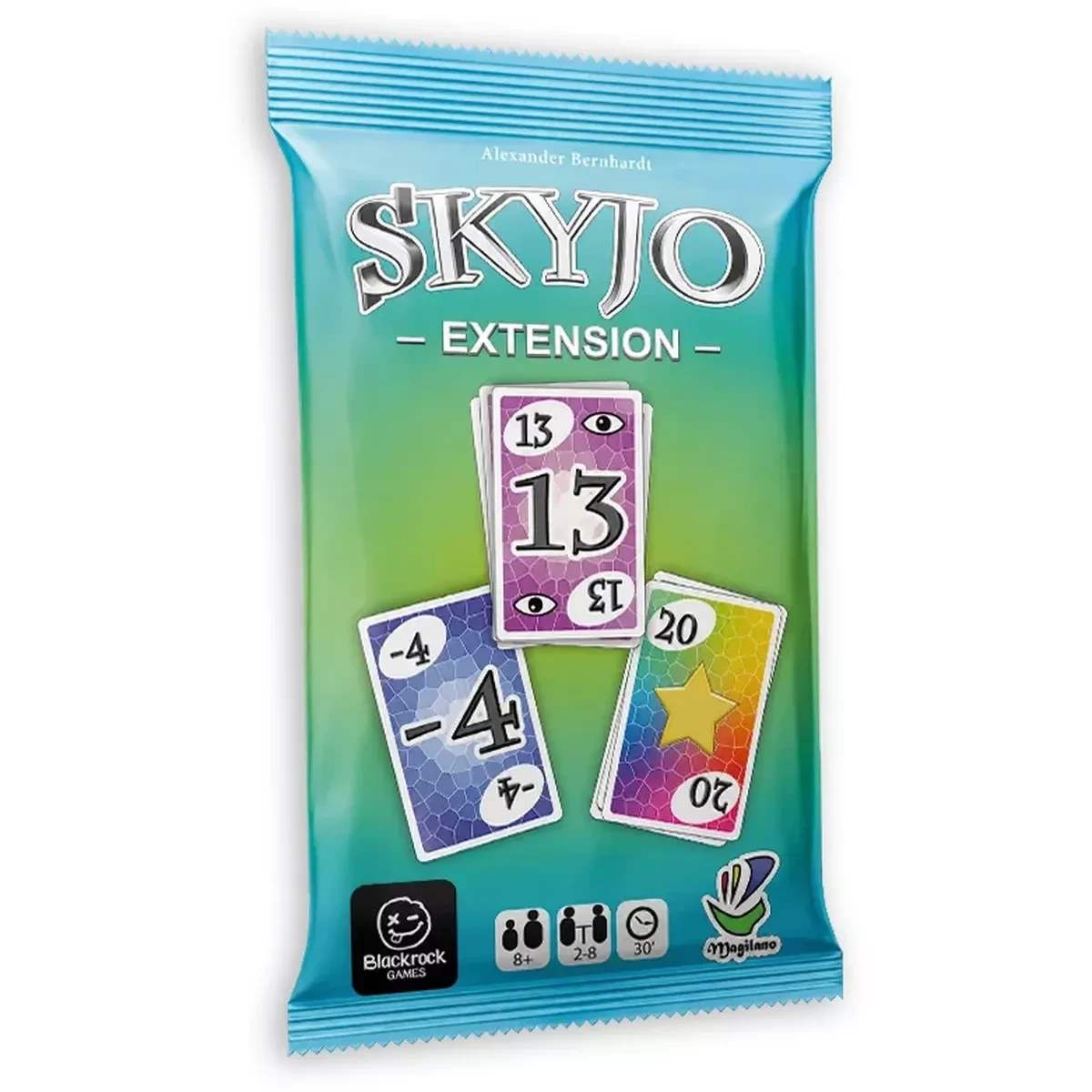
The new SKYJO expansion adds ten 13s, one minus-four and three stars to Classic. The tempting part is what they let you do; the important part is what they cost if your plan does not work. A 13 offers private information without erasing its score, and an unfinished star can leave you with twenty points.
Here is what the French 2026 pack contains, how its printed rules affect ordinary decisions, and why it should be kept distinct from SKYJO Action. The examples below explain the tradeoffs rather than promise a winning system. Availability information is specific to the retailers and date named.
What the new SKYJO expansion actually is
Look for the name SKYJO Extension on the French booster pack. This is a 14-card addition that requires Classic SKYJO, rather than a complete game in a smaller box. You shuffle its cards into the existing base deck and continue playing the familiar game with a few new effects. A buyer who owns only Action or Junior should not assume that any box carrying the SKYJO name meets that requirement.
Identification is especially helpful when shopping across languages. Playin's product entry lists the French edition as MAG020SK, barcode 4260470080186. Match the product photograph and those details to the seller's description. “Extension” means expansion here; it is not a digital subscription, a replacement deck, or another name for SKYJO Action.
| New card type | Copies added | Central idea |
|---|---|---|
| 13 | 10 | High points in exchange for information |
| −4 | 1 | A particularly low score contribution |
| Star | 3 | Flexible column building with an expensive failure case |
Ten of the fourteen cards are 13s. That composition is the first clue to the design: the expansion does not simply make the deck kinder. It adds a high value worth thinking around, one unusually attractive negative card, and three opportunities to complete columns in a new way. A good introduction should explain the liabilities as clearly as the benefits.
The French launch has an observable October 2026 footprint. Antre des Jeux included the pack in its October 16 arrival announcement. That is specific evidence of a shop receiving the product, not a universal release calendar. Retailers can receive allocations at different times, and an English-language shop page does not automatically mean the supplied rules are English.
Availability also varied on October 25: Playin's live entry showed no delivery stock, while Ludum's listing showed stock. Check the seller you intend to use instead of relying on a search snippet or another country's announcement. If Classic is new to your group, start with the base rules; this booster makes more sense after players understand ordinary replacement and column removal.
How the 13, minus-four, and star cards change a turn
The rules printed on the expansion pack retain the base game and add three specific card instructions. That distinction keeps the teaching manageable: explain what each card changes, then keep ordinary drawing, swapping and column play familiar. Do not infer an extra ability simply because a card looks special.

The 13 trades a high score for information
A 13 is worth thirteen positive points. When one is turned face-up in your grid, immediately and secretly look at one of your own cards that remains face-down. The location matters. Drawing a 13 and looking at it in your hand is not the same event as turning it face-up in your layout. Nor does seeing a 13 in the central discard pile give everyone permission to peek.
Imagine revealing one of your dealt hidden cards and finding a 13. You inspect another hidden position, discover a 10, and leave that inspected card hidden. Your information has improved, but the board has not magically become cheaper. You still have the visible 13 and the hidden 10. What changed is your ability to choose a useful replacement on a later turn.
The peek does not itself exchange a card, grant another turn or cancel the thirteen points. If the secretly inspected card is already low, you may prefer to protect its position and work elsewhere. If it is high, you have found a priority. That choice is more meaningful early enough to exploit it. With no hidden card left in your own grid, there is no eligible card to inspect; another player's hidden layout is not a substitute target.
The minus-four is valuable without a special power
The single −4 is the straightforward addition: it contributes minus four to your score. It does not need an eye symbol or another effect to be attractive. Replace a visible 9 with −4 and the contribution from that position falls by thirteen points. This is a clear benefit you can calculate before choosing it.
Its simplicity is also a useful teaching point. New players sometimes assume all the expansion cards must trigger a separate action. The minus-four has no such instruction: take it through an ordinary legal replacement, retain it if that suits your board, and count its negative value when scoring. It does not independently clear the other cards in its column.
A very low card can still distract you from a costly layout. Preserving −4 while several high cards remain unresolved may be sensible locally and insufficient overall. Compare your whole grid and the likely remaining time; do not let the most desirable-looking card become an excuse to ignore a visible problem elsewhere.
Stars help clear columns but carry a scoring risk
A star substitutes for a value when completing a column for removal. The uncomplicated example is a vertical column containing two visible 8s: a star fills the missing matching role, allowing that column to go. A column containing 8, 5 and a star does not become three equal values. The star can supply a number; it does not make two different existing numbers agree. The Classic three-card column rule remains the starting point.
The crucial bill arrives at scoring: each star still in your grid costs +20. A star used to finish a clearable column has an immediate purpose. A star placed beside unrelated cards while you hope for a future match is a speculative commitment. Both choices can look clever when you take the card, but they expose you to very different outcomes if the round ends sooner than expected.
A worked round: when a helpful card becomes expensive
Consider an illustrative round rather than a promised winning sequence. You reveal a 13, use its peek to discover a hidden 10, and now have two expensive positions you understand. On a later turn you can replace the visible 13 with a 2. That lowers your score contribution by eleven points. Alternatively, a good replacement might be directed at the known hidden 10. The information helps you identify the choices; it does not make either replacement happen automatically.
This is why “I got to look” is an incomplete evaluation. Ask what the look lets you do next. Finding an unexpectedly low hidden card can prevent a wasteful replacement. Finding a high card creates a target. In either case the gain depends on future opportunities, while the thirteen-point exposure exists now. The product's effect description makes that information-versus-value tradeoff explicit; the following numbers show its practical importance.
Separate a card's printed value from the decision it enables
Now compare three possible columns. These are independent examples with the rest of the board held aside, so the arithmetic is visible. None requires an unusual interaction or a guess about how multiple stars combine.
| Column | Situation | Contribution if resolved this way |
|---|---|---|
| 8, 8, star | Star completes matching column; it is removed | 0 from the removed column |
| 8, 5, star | Unmatched column remains at scoring | 8 + 5 + 20 = 33 |
| 8, 5, 2 | Unmatched numeric column remains | 8 + 5 + 2 = 15 |
The middle column is eighteen points more expensive than the last. If all your other remaining cards total six, the speculative star layout produces thirty-nine points before considering any separate finishing penalty. That is a large bill for a layout that may have felt nearly solved. The danger comes from the unresolved card, rather than the number of positions still on the table.
Before taking a star, identify its actual job. Do you already have a visible equal pair it can complete? Are you instead relying on finding another useful number later? How close are opponents to finishing? Their visible progress is not a precise countdown, but it is a reason to reconsider a plan that requires several more opportunities. A possible future column is not yet a cleared column.
These examples are decision aids, not proof that every speculative star is a mistake. A risky line can succeed, and a reasonable choice can lose to an inconvenient ending. Review the information available when you chose, rather than judging only the final reveal. The broader SKYJO strategy guide helps with that habit: compare immediate savings, unresolved high values and what your next few turns would need to accomplish.
SKYJO expansion versus SKYJO Action
The shared name and rainbow stars make these products easy to confuse. Their practical jobs are different. One supplements the Classic box on your shelf; the other provides a separate game with its own interaction and scoring system. Decide which sort of change your group actually wants before comparing prices or photographs.
An add-on deck and a standalone game solve different problems
The expansion preserves Classic as its foundation. Its new choices arise inside that existing framework: a peek attached to a high card, a lower negative value and a risky column wildcard. It does not provide a separate action-card market or a menu of attacks on other players. That modest scope may be exactly right if your group enjoys Classic and wants a fresh decision without learning another system.
Magilano presents SKYJO Action as a game containing number, star and action cards. Action effects include swaps involving other players, which create a different reason to watch the table. Choosing that box is therefore a decision about interaction and rules, rather than a more expensive way to obtain this booster.
| Question | Classic + Extension | SKYJO Action |
|---|---|---|
| What must you own? | Classic base game plus the 14-card pack | The standalone Action box |
| Separate action deck? | No | Yes, alongside the playing deck |
| Unremoved individual star? | +20 points | 0 points |
| Main addition to consider | Information and risky column completion | Dedicated actions and broader interaction |
Action's stars and action cards are a separate rules system
The star difference is decisive: the expansion's +20 is not Action's zero. The official Action rules keep Action stars neutral in value even when used for a temporary number conversion. They also allow qualifying matching sets in complete horizontal rows or vertical columns. Importing that whole system into Classic would alter far more than the booster instructs.
Action also makes drawing a playing card, obtaining an action card, and playing or discarding an action card alternative ordinary turn choices. Do not teach it as an automatic free action after every normal draw. If those choices interest your group, use the Action overview to explore the separate game, with its own rule sheet beside you.
For the expansion, follow the pack and Classic rules together. Neither the visual resemblance of the stars nor ownership of both boxes establishes a published combined mode. Keeping the decks separate makes it easier to teach the intended game and to understand why the same-looking symbol can encourage very different decisions.
Who is likely to enjoy the extra uncertainty
The clearest audience is an existing Classic group that still likes the core game and wants a few fresh dilemmas. Retailer descriptions position the pack as a small renewal of that familiar experience. That is a useful description of its scope, although it is not independent evidence that every group will enjoy it more.
Players who like deciding what information is worth may find the 13 interesting. Knowing one hidden value can stop you from throwing away a good position, or make the next useful draw easier to place. People who enjoy a visible risk may prefer the stars: everyone can understand why a completed column is attractive and why an unfinished star is alarming. The extra tension comes from different sources, even though both cards complicate the temptation to take whatever looks helpful.
For someone whose main complaint is that SKYJO has too much luck, the pack deserves a more cautious recommendation. It offers another way to learn information, but it also introduces high-value cards and a larger star penalty. Those ingredients do not remove shuffled draws or hidden starting cards. Calling it a cure for randomness would confuse having additional decisions with controlling the outcome.
It is also not automatically a faster version. A group may recognize the new icons quickly, yet spend longer discussing whether a peek justifies exposure or whether a star has a realistic future. That is an analytical possibility, not a measured playtime claim. If your favorite feature is an almost conversational pace, consider whether your players enjoy those pauses before expecting the extra choice to be an improvement.
For newcomers, an ordinary Classic round provides useful context. The column wildcard makes more sense once someone has experienced trying to collect three equal numbers; the peek makes more sense after a blind replacement has revealed an unexpectedly good or bad card. You can then teach the expansion with actual decisions in mind, instead of presenting three more symbols before the base turn is familiar.
My recommendation follows those differences: choose it for fresh risks within Classic. Choose it because your table wants to debate an information tradeoff or a tempting column, rather than because the packaging promises more strategy. If players already dislike managing unresolved high cards, making the possible consequences sharper may amplify that frustration. A small pack can be a good fit without being a necessary upgrade.
Before buying or mixing the cards into your deck
Buying a small expansion should be simple, but regional product pages can create more confusion than the rules. Use the pack identity and the seller's current delivery terms together. A news story establishes that the product has appeared; it does not reserve a copy, establish shipping to your country or settle which language you will receive.
Check the edition, language, and local release listing
On October 25, Cultura's listing displayed availability from October 26. Other French stores had already announced the expansion earlier in the month. These can be different retailer schedules rather than competing claims about one worldwide launch. Treat an advertised future date as that seller's information, and check it again when ordering.
- Confirm the required base game. You need Classic SKYJO. The fourteen-card booster alone is not a playable substitute for the full deck.
- Match “SKYJO Extension,” the physical pack photograph, reference MAG020SK and barcode 4260470080186. A seller grouping all SKYJO products together may place Action and the expansion close to one another.
- Read the language field. Playin provides an English website description while identifying the product language as French. Do not translate the website's interface into an assumption about the pack's instructions.
- Check delivery separately from pickup. Local stock, shipping stock, preorder and an indexed search result can describe different situations. Your region may have additional delivery restrictions.
- Use the buying guide as a starting point for identifying editions, then rely on the actual retailer's current listing for this specific pack.
Once the pack arrives, count the ten 13s, one −4 and three stars before shuffling. Show everyone the icons while the cards are still together. Explain the 13's private look, demonstrate one ordinary equal-pair-plus-star column, and say the star's twenty-point cost out loud. That final warning is easy to lose if the introduction concentrates only on exciting new powers.
Keep the packaging or identify the fourteen additions so you can remove them before another session of unexpanded Classic. Avoid changing the deck halfway through a round because somebody dislikes a newly discovered consequence. Teach the complete bargain first, finish the agreed game, and then decide whether the extra information and risk suit your table. That is a more useful test of this small expansion than expecting it to transform every reason you play SKYJO.


Loading comments...