SKYJO Action rules
SKYJO Action Reactivation and Double Move: Timing and Combo Examples
Understand which card is ready now, count each granted move, and avoid turning a useful recovery into a timing dispute.
The timing rule that makes the combo work
Before combining Reactivation with Double Move, count what an ordinary turn actually buys. In the boxed SKYJO Action game, you choose one of three alternatives: draw a playing card, take an action card, or play or discard an action card you already hold. Resolving that choice normally ends your turn. The English Magilano Action leaflet describes these alternatives under Gameplay. There is no general permission to spend several action cards and then take a free number-card turn.
The useful question is whether your proposed sequence spends a turn or receives one from an effect. Imagine that an open 0 is available on the playing-card discard pile, while you hold Reactivation and can see Double Move in the action discard pile. Taking the 0 is one possible turn. Playing Reactivation is a different possible turn. You do not get the 0 first and then add Reactivation merely because you have not passed the cards to your neighbour yet. An effect can grant further moves, but the permission has to come from that effect.
| Your choice | What you resolve | What you should not add automatically |
|---|---|---|
| Playing card | The normal take-and-replace or draw-and-decide procedure | A separate action-card play |
| Action card acquisition | Take a card from the action display or draw pile | Immediate use of that newly acquired card |
| Action card play | The effect printed in the rules for that action | An unrelated playing-card draw unless the effect grants one |
Keep the two discard piles physically separate. A tempting number on the playing discard is not an action that Reactivation can recover. Equally, taking an action card means putting it face up beside your layout, not replacing a number in your twelve-card grid. Before reaching for a discarded symbol, say which discard pile it belongs to. The two piles offer different choices even when their cards are equally visible.
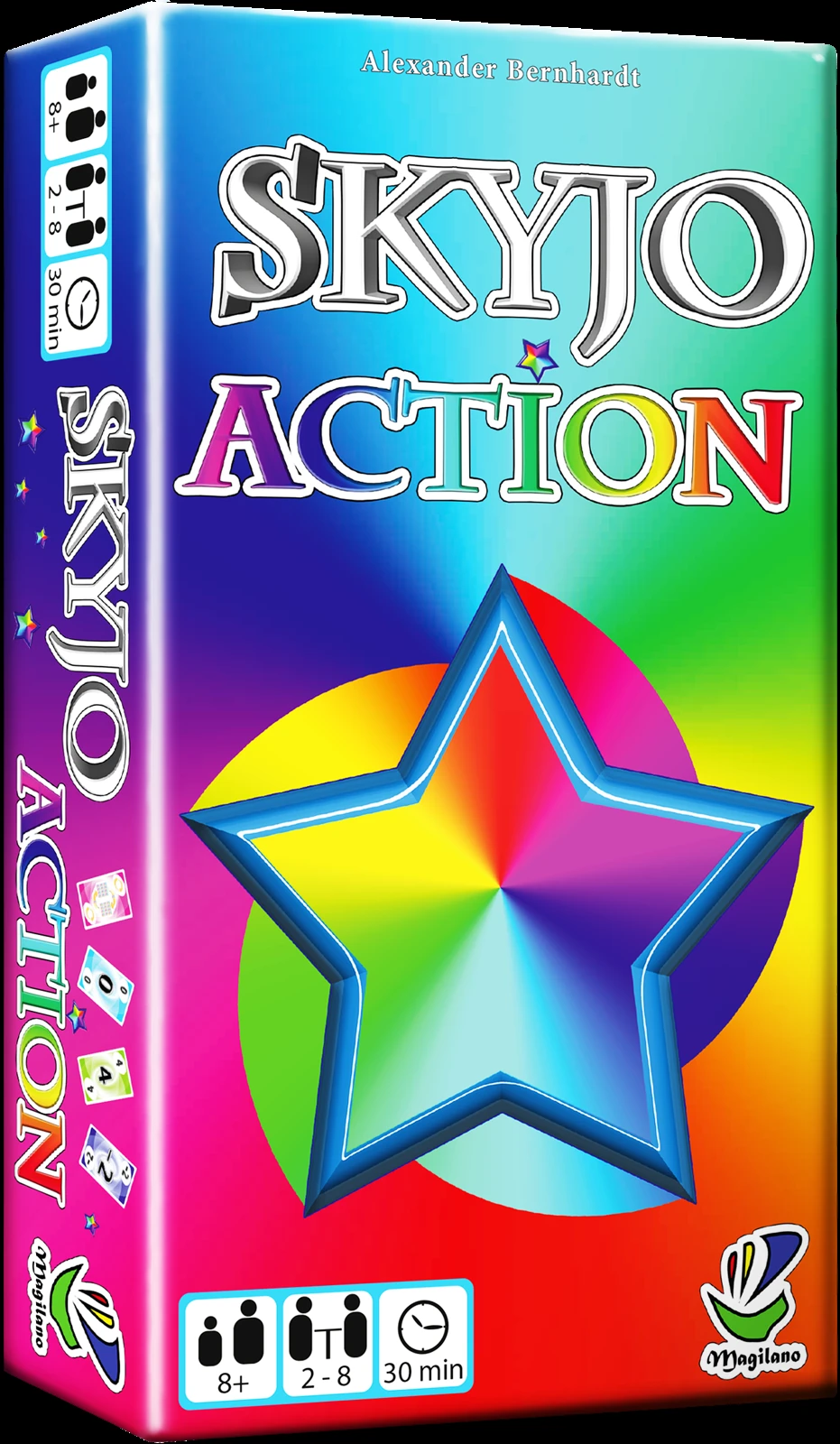
This guide uses the standard, separate-deck SKYJO Action rules. Classic SKYJO does not contain these actions, and an app may implement a different sequence. If you need help identifying the symbols, use the Action card overview alongside your leaflet. For the examples below, a “move” means one of the ordinary turn choices; additional moves are permissions created by an action, not extra cards drawn for free.
Reactivation: what you can use immediately
Recovering from the action discard pile
Reactivation lets you select an action from the action discard pile and play that selected action immediately. The German wording in the same publisher leaflet explicitly describes choosing from the entire pile, so you are not limited to its top card. The important exception is the recovered action's immediate use. It does not mean that any Reactivation you have just collected can immediately leap out of your reserve.
Suppose you already hold Reactivation from an earlier turn. Enlightenment is buried under several spent actions. You choose to play Reactivation, select that Enlightenment and resolve its look-at-a-row-or-column effect immediately. You do not put Enlightenment beside your grid and save it for later; the recovery requires immediate play. Once the actions finish, the spent cards belong in the action discard pile. Unless the recovered action itself grants further moves, your turn is over.
Now change one detail. You do not own Reactivation yet, but one is showing among the four available actions. Taking it is the action-card acquisition alternative. That acquisition does not also activate it. If you are planning a rescue through the discard pile, you need enough time to collect the tool and then use it. Before taking it, count whether an opponent is close to exposing a final hidden card. An attractive discard pile is useful only if you will have time to act on it.

Why a newly earned action card usually has to wait
The same distinction matters when a star earns you an action card. Acquiring an action through a star is not a blanket permission to play the new card during that move. For example, you replace an 11 with a qualifying star and take Reactivation as the star reward. The star has improved your playing layout and supplied a future option, but you cannot immediately recover Double Move merely because the reward happens to be Reactivation.
Nor can you keep moving an already exposed star around to manufacture the same reward again. Its acquisition entitlement is a one-time event under the star rule, not a permanent action generator. Our Action star-card guide covers their broader use; here, the practical point is to track where each action came from and when it became available.
Be particularly careful with stolen actions. Action Card Thief has its own wording tying use of the stolen card to a subsequent turn after a player's turn has intervened. Do not replace that specific condition with “I have another move, so every stolen card is ready.” For a disputed combination, identify the acquisition route first. Put the card in its actual history: recovered now, selected from the display this turn, or stolen from a player. The symbol alone cannot answer whether it is ready.
Double Move: two complete turns, one after another
Double Move grants two consecutive moves. Think of them as two opportunities to make the normal three-way choice before play passes clockwise. They are not automatically two blind draws, nor a licence to draw several cards at once and decide afterwards which result belongs to which turn. Reactivation can supply the Double Move effect immediately, but it does not add a separate third playing-card move on top.
A turn ledger with one recovered Double Move
Consider this teaching position: you already own Reactivation, Double Move is in the action discard pile, and your layout contains visible 11 and 8 cards in different, nonmatching lines. Several other cards remain face down. The playing discard shows 0. No replacement in this example completes an equal-number line or reveals anyone's final hidden card.
| Step | Legal resolution | State afterwards |
|---|---|---|
| Start | Play your previously owned Reactivation and immediately use the recovered Double Move. | Two consecutive moves are available. |
| Move 1 | Take the open 0 and exchange it with your visible 11. | 0 is in your layout; 11 is now the top playing discard. |
| Move 2 | Draw from the playing deck. In this example it is 2; exchange it with the visible 8. | 2 is in your layout; 8 becomes the top playing discard. |
| Finish | Both granted moves have been used. | Play passes to the next player. |
Your visible numbered total fell by seventeen: eleven points from the first replacement and six from the second. That is an illustration of a favourable draw, not a promised result from the combo. If the second draw had been 12, you would face the normal choice of keeping it or discarding it and revealing a hidden card. Double Move creates another decision; it does not improve the deck's next card.
What changes between the first and second turn
Finish the first move before beginning the second. Update the playing discard, resolve any applicable completed-line removal and reassess the layout. In the example above, the open 0 is gone after move one. You cannot take it again from the discard on move two. In another position, removing a line could place a different card on top of the playing discard, creating a useful second pickup that did not exist when you started.
You also choose each move's type separately. For example, you could take a displayed Enlightenment on the first granted turn and use that normally acquired card on the second: the second is the next turn for the ordinary acquisition rule. You would spend the sequence obtaining information rather than making two replacements. This is a different route from Reactivation's immediate recovery, and stolen cards retain their specific restriction.
Choose a purpose for the pair before you begin. Two replacements may be best when your layout is expensive; information followed by a later plan may be better when it is mostly unknown. If the second move has no useful job, another recovered action may solve the position more directly. A longer sequence has no value merely because it is long. The broader SKYJO Action strategy guide develops that connection between actions, information and closing risk.
Can Reactivation and Double Move create an endless loop?
The two card names alone do not demonstrate an endless loop. A January 2025 player discussion describes a very long turn involving Reactivation, repeated turns and several available Reactivations. The commenter also questions whether the rules were being interpreted correctly. That is useful evidence of a frustrating table experience, rather than a publisher ruling or proof that every such combination repeats forever.
There are two separate questions here. Can one player make several decisions before the next person acts? Double Move expressly creates consecutive moves, so yes. Can a player repeat the identical sequence indefinitely without spending a limited resource or changing the position? That requires a complete repeatable sequence. A story about a turn taking ages does not supply one, and the printed leaflet does not give a worked recursive-loop ruling.
Follow the cards, not just the effect names
Start with a modest position: one Reactivation beside your layout and one Double Move in the action discard pile. After recovering Double Move, you have its two moves to resolve. You do not automatically have Reactivation back in your reserve, ready to play again. Before saying “repeat,” identify how the next action is acquired, when it becomes playable and which actual discarded card it will select.
A longer finite example is easier to explain. Begin with two previously owned Reactivations. Use the first to recover Double Move. For the first granted move, play your second Reactivation and recover Enlightenment, immediately inspecting a chosen row. For the second granted move, make an ordinary playing-card choice using the information you learned. You have spent two owned recovery cards to inspect and then act before the next player intervenes. No card has acquired a permanent ability to activate itself.
Replacing Enlightenment with another Double Move introduces a further question about consecutive effects and when the resolving cards enter the discard. Record those steps instead of silently assuming every card is already available for recovery. The general rules describe discarding a played action after its resolution; they do not provide a detailed recursive scheduling example. An immediate recovery instruction is not, by itself, a complete explanation of an arbitrarily deep repeat.
For that reason, neither “official infinite combo” nor “officially limited to one Reactivation” is a reliable blanket answer from the material above. If your group claims a self-sustaining cycle, write the exact starting cards and each resulting location, including any cards collected from the display. A missing acquisition step or an action used before it is ready invalidates that particular demonstration. If all the ordinary permissions are satisfied but the dispute concerns unresolved nested timing, describe that exact case when seeking a publisher clarification.
This approach also makes complaints more useful. A player waiting through five explained moves may dislike the pace while agreeing that the sequence works. Another group may be granting free action plays that the ordinary turn rule never supplied. Those situations need different fixes: a voluntary agreement about pace for the first, and a correction to the turn sequence for the second.
The final-round stop overrides your saved combo
The most expensive timing mistake is saving a beautiful recovery plan until it is no longer legal to begin it. Once the round's closing condition has been triggered, action cards may neither be played nor discarded during the final phase. Having owned Reactivation for several turns does not override that restriction. Neither does the fact that Double Move is sitting conveniently in the discard pile.
Suppose the player immediately before you reveals the last hidden card that triggers the close. You still hold Reactivation and Double Move. Your final move is not an opportunity to unload those actions or start a fresh chain. Resolve a permitted final playing-card move instead. The window for playing or discarding a saved action has closed, even though the table has not yet calculated everyone's score.
Unused actions matter because each one remaining beside your layout contributes ten points. For example, a numbered subtotal of eight plus two retained actions gives twenty-eight before any other applicable scoring adjustments. Saying “I will throw these away now” during your last move does not undo that twenty-point exposure. Discarding an action without its effect was a turn choice earlier in the round, not an emergency cleanup right at scoring.
Watch more than your own hidden cards. In Action, a player can trigger the end by revealing the last hidden card in somebody else's layout. A nearly open opponent can therefore become part of an attack or swap decision, and the active player's move can close your action window sooner than you expected. Simply keeping one hidden card in your own grid is not insurance that you will have another safe opportunity to spend Reactivation.
The practical adjustment is to use a good available action while it still has a useful job. A modest recovery that removes an expensive card from your reserve can be preferable to waiting for a spectacular Double Move. That is a judgement about the visible position, not an instruction to spend everything immediately: early in a round, preserving flexibility can still be valuable. Near a likely close, count the retained actions as actual exposure rather than invisible future power.
For a compact discussion of how one opponent's choices change that calculation, see two-player Action timing and endgame examples. Whatever the player count, announce the closing trigger clearly. Everyone should know the action window has ended before the next person reaches for a saved card.
A practical way to resolve a timing dispute
When a sequence becomes confusing, pause at the current move rather than arguing from the final result someone wants. Ask four concrete questions: which move is being spent, where did the proposed card come from, what instruction permits its use now, and where will the resolving cards go afterwards? These questions expose a skipped turn or an unavailable recovery target without needing to reconstruct ten decisions from memory.
Use the leaflet for your edition. Magilano's download page separates SKYJO Action from Classic and Junior. This matters when a search result presents a perfectly correct Classic explanation that has nothing to say about action-card timing. Likewise, an online game's implementation can show how that program behaves without deciding a disputed rule at a physical Action table.
Three situations to test before your next game
- You take Reactivation from the four-card display. Can you immediately select Double Move from the discard? No. You have used the acquisition alternative. The immediate-use instruction belongs to the action that Reactivation later recovers, not to collecting Reactivation itself. State this distinction aloud before anyone starts searching the pile.
- You already own Reactivation and recover a discarded Double Move. Must both granted moves draw numbered cards? No. They use the ordinary turn choices. Resolve the first completely, update the position and then choose the second. Neither decision comes with an unrelated bonus draw.
- The close has been triggered and you hold two unwanted actions. Can you spend your last move discarding them? No. Playing and discarding actions are both prohibited in the final phase, and each retained action still matters at scoring. Waiting until the final turn is too late.
Notice what these tests do not need: a ranked list of powerful cards or a claim that everyone should pursue the same combo. They establish a shared sequence. Once the sequence is clear, players can disagree reasonably about whether an action was worth taking, whether information was useful or whether a safer replacement would have been better. That is strategy discussion rather than a timing dispute.
If legal extended sequences still make the evening drag, agree on a pace change before the next round. For example, your group could allow at most one Double Move effect between different players' turns. That is an optional house rule proposed for predictable pacing; it is not a restriction printed in the Action leaflet or an official answer to recursive timing. Everyone should understand the change before choosing which actions to collect.
For a first teaching game, the publisher also allows tailoring the action selection and specifically suggests setting aside Action Card Thief and Meteor Shower for beginners. That reduces additional interactions while players learn the ordinary alternatives. It does not rewrite Reactivation into a freely playable bonus card. Start with the turn choices, demonstrate one finite recovery sequence and keep the card locations visible. The combo becomes much easier to discuss when each extra decision has an explicit reason to exist.

Loading comments...