Physical SKYJO Action | Scoring examples
SKYJO Action Final Scoring: Overlapping Lines and Star-Card Examples
Finish the last turns, clear valid lines, allocate stars once and include unused actions. These worked examples also explain what to do when a crossing-line question goes beyond the ruling you can actually find in the booklet.
Start with Action rules and a complete scoring position
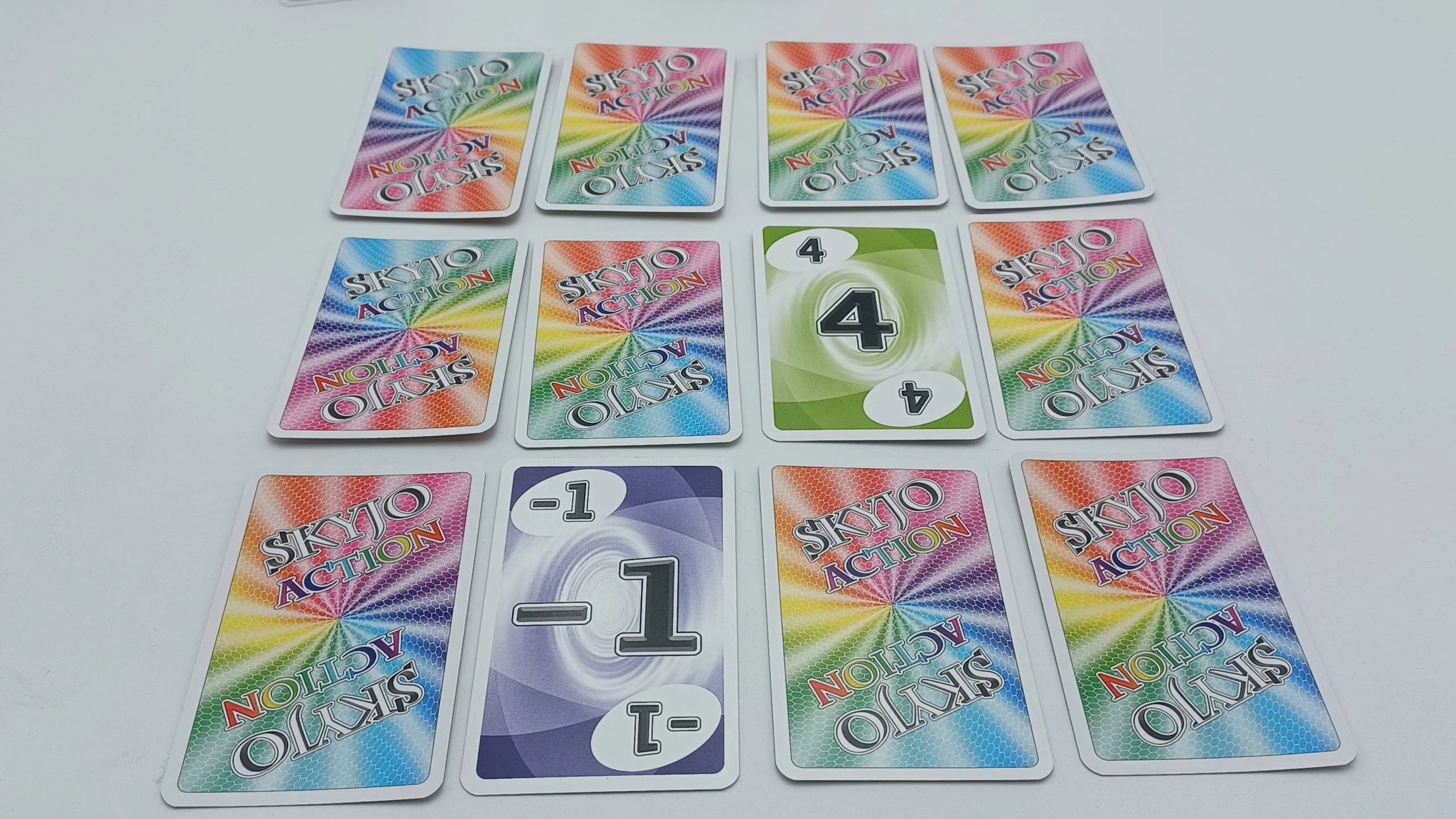
Before counting, place the SKYJO Action instructions beside the table. This guide covers the normal physical Action edition, whose numbered and star cards form one deck and action cards another. Its starting display is twelve playing cards in four columns of three. The worked positions below are invented teaching examples, with any unresolved convention stated explicitly. They are not screenshots of a tournament ruling.
Why Classic scoring answers can send you astray
Action adds scoring questions that a Classic-only answer cannot settle. Horizontal lines and stars matter, and the action cards beside your display contribute to the final account. A familiar explanation about three equal cards in a vertical column therefore covers only part of the job. Use the publisher's Action rulebook as your baseline; a page calling itself an official rules site is not necessarily the publisher.
A player discussion about final reveals illustrates the confusion: a reply first says only columns can disappear, before the conversation clarifies that the question concerns Action. The thread identifies a real teaching problem, but it does not supply an authoritative crossing-line decision. Having more people agree with a reply would not change that distinction.
Keep three parts of the position visible: the playing grid, the unspent action cards and the identity of the player who triggered the finish. These are different pieces of information. Do not assume that the person with a fully exposed display must be the person responsible for ending the round. Do not sweep unused actions away with the central decks before their owner has accounted for them.
For a disputed finish, photograph the unchanged display and label its rows and columns. A simple coordinate description such as middle row, second column is easier to review than a handful of cards already mixed into the discard. Preserve gaps and orientations too; rearranging cards for neatness can change the position you are trying to explain.
If you need the full turn procedure first, our Action rules guide provides that background. Here the focus is narrower: finish the remaining play, identify valid removals and star sets, then produce a score that another person can reproduce from the same cards.
Finish the last turns before revealing the remaining cards
The published finish can be triggered by revealing your own last hidden card or someone else's. Every player except the person who triggered it receives one further turn. Mark that person immediately. In a clockwise game with A, B, C and D, suppose B exposes C's final hidden card. The remaining sequence is C, D, A; B does not receive another move simply because B still has hidden cards.
What changes on the final turn
Action cards cannot be played or discarded in the final phase. That restriction matters to anyone holding a plan to unload them later. A newly exposed star does not give permission to ignore the restriction. Keep any retained action cards beside their owner until the score is complete. A surprise star is not a fresh opportunity to start an action-card combination after ordinary play has closed.
For example, D holds two unused actions and has one final opportunity to improve a visible 11. D cannot treat the turn as a free cleanup phase for those actions. The useful question is what the permitted playing-card choice can improve, with the retained cards still part of the eventual account. Do not silently remove them because they now feel unplayable; their lost usefulness is exactly what makes holding them late risky.
Track the remaining players explicitly. If C reveals a final hidden card on C's allocated last turn, that does not restart another circuit for D, A and B. The table is already in its closing sequence. A counter or brief note avoids the common argument that each newly completed display creates a fresh finish.
Turn over cards without inventing extra turns
After the remaining turns, expose hidden cards for accounting and evaluate the resulting position. The Action rulebook still permits qualifying line removals and star conversion at this stage. Revealing a helpful number therefore matters, even though you are no longer choosing an ordinary replacement move.
Suppose A finishes the last turn with a column showing 7, 7 and one hidden card. If that card becomes a 7 during accounting, evaluate the completed column before summing the remaining display. If it is a 2, count the resulting values unless another valid line removes them. A cannot now draw again to search for the missing 7. Scoring exposure supplies information, not another turn.
Do not claim that a left-to-right reveal order or an all-at-once reveal is automatically a published crossing priority. Turn every remaining card face-up while preserving its position, then pause if competing removals need a decision. The next examples explain ordinary clear cases first, before addressing the boundary that generates the argument.

Clear a matching line before adding the remaining numbers
A complete equal-number horizontal or vertical line containing at least three cards must be discarded, including negative-number lines. At the original width, a horizontal row contains four cards. Three matching cards beside an unmatched fourth are not a complete row. Apply that distinction before doing arithmetic; counting every visible card and trying to subtract a guessed bonus later invites mistakes.
| Invented position | What to check |
|---|---|
| Vertical 8, 8, 8 | Complete equal-number column; remove it. |
| Vertical 8, star, 8 | Using the star to match allows removal; its own numerical value remains zero. |
| Horizontal 6, 6, 6, 2 | Four-card row is not equal; three adjacent 6s are insufficient. |
| Vertical -1, -1, -1 | Negative values do not make the compulsory rule optional. |
The star example eliminates sixteen numbered points, not twenty-four. The star can supply the match without acquiring the printed value of an 8. This distinction matters when a player explains a large improvement: the relevant change is the numbered values removed, while the physical star is no longer available for a retained star set. A useful match can therefore have an opportunity cost beyond its immediate numeric effect.
For a negative example, imagine three -1s in a column and four points elsewhere in the display. Before applying the clear, the numbers sum to one. Removing the negative column leaves four. The increase is correct under the compulsory rule, rather than a reason to keep the column. Do not make the rule depend on whether the affected player likes the resulting total.
Keep the discarded line separate for a moment while another player verifies the subtotal. If the line followed an exchange, the exchanged-out card goes below the removed line on the discard pile. Choosing the order of cards within that removal can affect which card is available to a later player during play. That placement choice should not be confused with an independently established rule for competing crossing lines.
Once an ordinary removal is agreed, count the cards that actually remain. Do not count the discarded line as zero and also award a second numerical reduction for the same cards. Most easy scoring disagreements disappear when everyone points to the same surviving physical cards before announcing a subtotal.
Handle crossing lines without inventing an official priority
The English rulebook allows a freely chosen discard placement order, and its German version likewise discusses the order of discarding. That wording does not provide an explicit worked ruling for every pair of crossing lines revealed at scoring. We did not locate a publisher clarification that establishes universal row-first, column-first or simultaneous-union handling. This is a limit of the available evidence, not proof that no clarification exists anywhere.
The crossing examples below are conditional table-convention examples. They show why the question matters; they do not declare either order officially correct. In particular, permission to order cards on the discard pile should not be silently expanded into permission to choose any scoring result.
A numbered cross shows why the order matters
Imagine this fully revealed display. The middle horizontal row contains four 5s, and the second vertical column contains three 5s. Both include the same central card. All twelve cards sum to fifty-three before any clear.
| 1 | 5 | 2 | 3 |
| 5 | 5 | 5 | 5 |
| 4 | 5 | 6 | 7 |
Suppose a group has explicitly agreed to remove one selected complete line, then check the surviving complete lines again. Under that convention, choosing the middle row first removes twenty points and leaves thirty-three. The second column now has only two surviving cards, so it cannot qualify as a three-card line. That is the row-first outcome under the stated assumption.
Under the same convention, choosing the second column first removes fifteen. The middle row then has three surviving 5s; if the convention treats that reduced row as complete, those fifteen also disappear. Twenty-three remains. The ten-point difference is why a casual instruction to clear everything is inadequate for this question.
Do not subtract twenty plus fifteen from fifty-three: the central 5 would be removed twice. Likewise, do not start sliding unrelated cards into a new arrangement to create an additional match. A physical position and a stated resolution procedure are both necessary before a subtotal means anything.
Agree on a convention before the next round
Keep the board intact while you consult the copy of the instructions in your box. If it does not resolve the exact intersection, ask the publisher with a photograph and the two candidate sequences. Describe whether the pattern appeared during a normal turn or the final accounting reveal. Those details are far more useful than asking whether rows or columns win in general.
For a casual game continuing without that answer, write down the convention everyone agrees to use and label it a table agreement. Specify whether removals are sequential, who selects the first eligible line, and whether reduced lines are checked again. Apply it consistently to every player. If the dispute has already affected a round, agree on a neutral settlement together; do not let the eventual score choose the interpretation retroactively.
Count star sets and unused actions as separate score items
Keep three entries separate: remaining numbered values, retained star-set bonuses and unused actions. An individual star is worth zero. A complete retained three-star horizontal or vertical line gives minus ten; a complete four-star horizontal line gives minus fifteen. All-star lines may be kept rather than discarded. Each physical star can contribute to only one counted line.
That last restriction answers an important part of the crossing question. Imagine an all-star horizontal row of four crossing an all-star column of three. They share one star. You cannot claim minus fifteen for the row and minus ten for the column while using the shared card in both. Mark the cards assigned to a counted set before claiming another. Two unassigned stars left in part of a line do not become a new three-star bonus through wishful arithmetic.
A star used to remove a numbered line is also physically gone. You cannot then include it in a retained star set. The choice can still be worthwhile: clearing expensive numbers may beat preserving a smaller negative bonus. Compare the actual cards affected and follow the agreed crossing procedure, rather than assuming every star should always be saved. Our star-card guide covers their broader role during play.
Work through one complete score calculation
For this invented example, assume all removals are settled, your surviving numbered cards total six, and you retain one eligible three-star column. Two unused action cards remain beside you. Count them before comparing yourself with anyone else: each costs ten points.
| Item | Contribution | Running round subtotal |
|---|---|---|
| Remaining numbered cards | +6 | 6 |
| One retained three-star column | -10 | -4 |
| Two unused action cards | +20 | 16 |
If you triggered the finish and an opponent's complete total is twelve, your positive sixteen doubles to thirty-two. If that opponent also has sixteen, equality still triggers the doubling. If someone else triggered the finish, you record sixteen without that finisher penalty. The identity recorded earlier determines which player is being tested.
Now change just one condition: suppose you had no unused actions. Six minus ten produces minus four. Even if an opponent scores minus seven, the zero-or-negative exception means your minus four is not doubled. This is why neither the numbered subtotal nor the sight of a star set alone tells you whether closing was safe.
Add the final recorded round score to the cumulative sheet only after this comparison. Keep a small annotation for a star bonus or action liability if your group often forgets them. The goal is an auditable number: another player should be able to recover the same total from the settled display and the retained action cards.
Teach a repeatable end-of-round check
Give the table a short routine before dealing the next round. The purpose is to make the same position produce the same explanation, even when someone is disappointed by the result. Keep the publisher's Action instructions available and separate your group's unresolved-case convention from the rules you can point to directly.
- Mark the person who triggered the finish and list the remaining last turns.
- Finish that sequence, then expose the remaining cards without rearranging the display.
- Identify complete lines and settle any crossing question using the previously agreed procedure or a publisher clarification.
- Identify retained star sets and ensure that each physical star is allocated only once.
- Write numbered subtotal, star bonuses and unused-action liability as separate entries.
- Compare complete totals for the finisher's positive-score test, then record the final round scores on the cumulative sheet.
Have a second player read the arithmetic back before collecting cards. This small pause catches an omitted action card or a star counted in two places while the evidence still exists. Once the cards are shuffled together, even a confident recollection can be hard to verify. A photograph is particularly useful for a crossing dispute, but it should preserve the whole display rather than crop away the relevant row.
For teaching, ask a new player to explain the difference between 6, star, 6 and star, star, star. The first can use the star for a numbered match; the second presents a retained star-set question. Then ask where an unused action belongs in the subtotal. These two checks expose most edition and category confusion without replaying the entire instruction booklet.
If clarification is still needed, send the publisher one exact scenario: the edition, a labelled display, when the pattern appeared and the candidate sequences with their different totals. Ask which sequence applies. That question is easier to answer than whether players may generally do whatever gives the lowest score. Until a documented answer arrives, describe your solution as a table convention.
For the decisions that lead into these positions, continue with our Action endgame examples for two players. During the score itself, slow down long enough to distinguish an established rule, a counting mistake and an unresolved intersection. Each needs a different kind of answer, and treating them separately keeps the next round enjoyable.

Loading comments...