Classic SKYJO · Research and strategy
Is SKYJO Luck or Skill? What AI Research Can—and Cannot—Tell Us
Separate better decisions from better draws, and understand what the research measures before turning its results into playing advice.
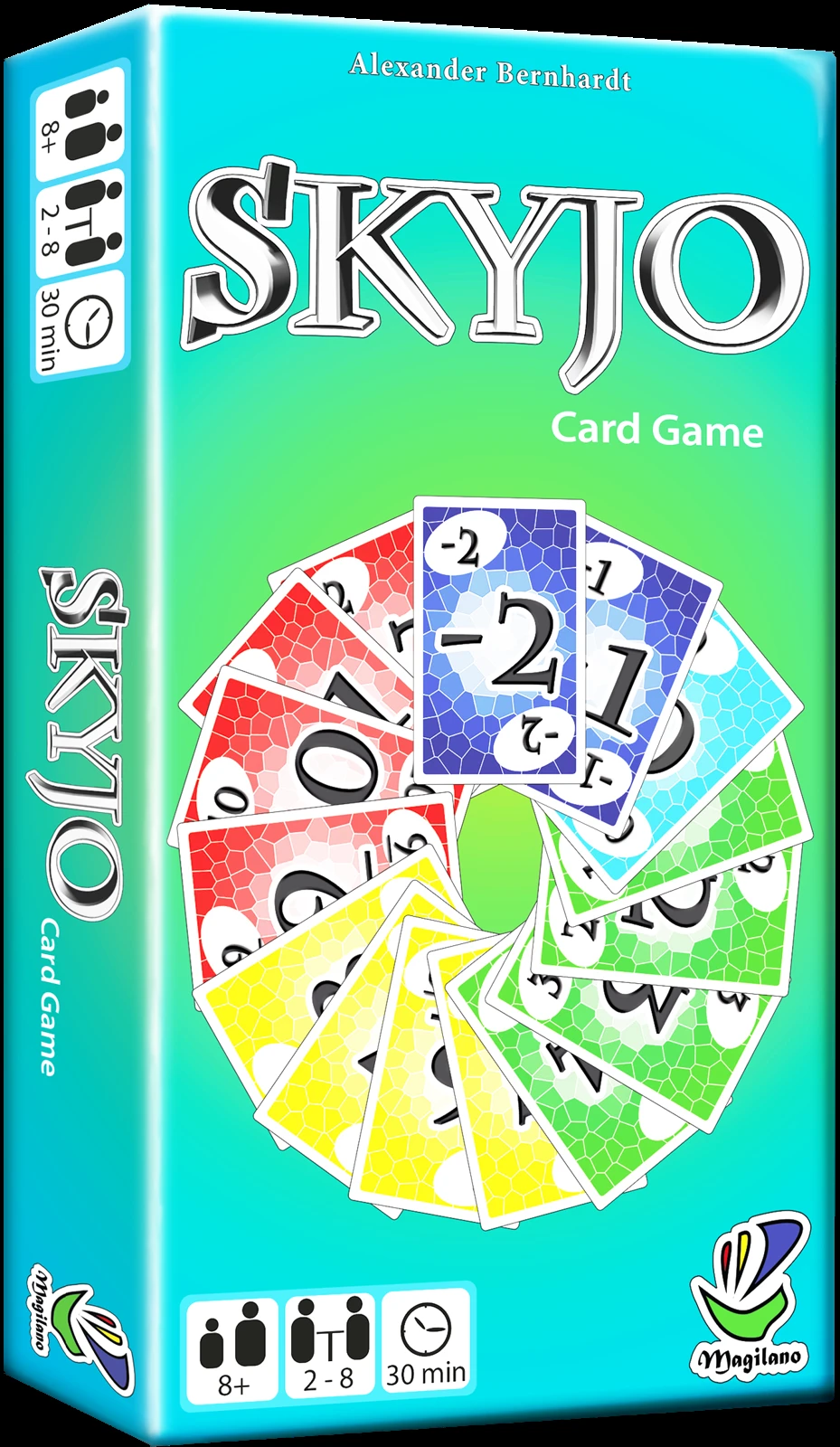
SKYJO has meaningful choices and unavoidable luck
SKYJO contains both. The shuffled deal and unseen draws create outcomes you cannot control, while your choices determine which opportunities you accept, which cards you replace and how quickly your layout becomes exposed. A useful answer therefore needs more detail than a slogan about being lucky. It also needs more evidence than the observation that one person won the last three rounds.
In Classic SKYJO, the first choice on a normal turn is between a known top discard and an unseen draw. Drawing unseen does not commit you to keeping the result: after looking, you may exchange it into your layout or discard it and reveal one of your hidden cards. That second decision matters. Two players receiving the same draw can leave different positions because they use the information differently. Our Classic rules guide explains the underlying sequence.
Consider a simple position with a visible eleven and no immediate matching-column complication. You draw a two and replace the eleven. Your known subtotal drops by nine points. That consequence is real even if an opponent subsequently draws a minus two and wins. The opponent's favourable draw does not erase your improvement. Equally, winning after a careless replacement does not prove the replacement was good.
Hidden information is a separate difficulty from random card order. You can know the values already exposed on the table without knowing your own remaining face-down cards. A reasonable decision must use that uncertainty rather than pretend the hidden cards are all average, all terrible or all safely negative. You are not allowed to inspect an outgoing hidden card before deciding to exchange it. The risk belongs in the decision itself.
This is why the research is interesting. Computer agents can apply different decision methods to the same kind of uncertain game and compare results over repeated trials. Such comparisons can show that one tested method performs better than another under the experiment's conditions. They cannot turn an ordinary table game into a guaranteed win, or automatically tell us what percentage of every human result is “skill.”
The practical interpretation is modest but useful: decisions can improve your prospects without controlling the next draw. If the frustrating part of SKYJO is that careful play can still lose, that frustration is compatible with meaningful choices. If the question is whether any choice matters at all, the turn structure already provides concrete differences worth evaluating.
What the SkyNet AI experiment actually tested
Adam Haile's SkyNet paper, submitted to arXiv in March 2026, compares a modified MuZero system with a baseline version. The modification adds training objectives for predicting the winner and ranking from the acting player's perspective. Its focus is learning useful representations under hidden information, not producing a short list of tips that solves SKYJO.
Planning with information the agent cannot fully see
The environment separates decisions that occur before a draw from decisions made after observing it. That is essential: choosing the deck is not the same decision as deciding what to do with the card it supplies. Unknown layout values remain hidden in the agent's observations. The system does not receive a magic view of every face-down card.
For a human player, the distinction is familiar. You may choose a blind draw because the open discard offers little help, then receive a low card that changes your replacement plan. It would be misleading to judge the original source choice as though that low draw had been visible all along. A sensible comparison must preserve the information available at each decision point.

Reading the 75.3 percent result correctly
The paper's head-to-head table reports 753 SkyNet wins, 240 baseline wins and seven draws in a thousand games at its iteration-one-thousand checkpoint. That is the reported 75.3 percent peak win rate against that baseline. The comparison alternated seats and matched training iterations. Earlier evaluated checkpoints favoured the baseline instead. The published table therefore describes a changing result during training, not an intrinsic win rate attached to the name SkyNet.
There are two especially important limits. The reported evaluation is two-player SKYJO, despite the architecture supporting larger tables. It also does not compare the model with human players. Neither a six-person family game's outcome nor your personal chances against experienced friends can be read from that figure. A machine beating another machine under specified conditions is a narrower, more useful claim than “AI proves anyone can win three games out of four.”
The experiment supports the idea that the tested decision methods are not interchangeable in that environment. It does not calculate a universal percentage of luck, prove perfect play or identify the best human strategy. The “belief-aware” name also should not be read as an exact running probability table for every hidden card: the paper's limitations explicitly distinguish outcome-focused representation learning from an explicit hidden-state belief model.
For players, the transferable question is therefore about reasoning, not imitation. Are you separating what you knew before drawing from what you learned afterwards? Are you judging the current layout in relation to the other player's position? Those are useful questions suggested by the problem design; they are not a claim that copying a few habits reproduces the trained system.
What the local-decision preprint can teach you
Felix Reichel's mathematical analysis of local SKYJO decisions addresses a different question from SkyNet. It studies immediate expected-score comparisons and tests simple threshold policies in simulation. The latest version available when this article was researched is version two, posted in April 2026. The page labels it as not peer-reviewed. Its own scope excludes a globally optimal multiplayer strategy.
A useful assumption is still an assumption
The useful starting idea is to compare a known replacement with the expected value assigned to an unknown card. If that unknown card is treated as exchangeable with the relevant unseen pool, the pool's average supplies a conditional estimate. It does not reveal the actual card. It also does not make every hidden position equally attractive once complete columns, remembered public information and the approaching end of a round become relevant.
“Local” is doing important work here. A replacement might improve the expected subtotal immediately while changing which cards remain hidden, how soon the round can close or what discard you offer the next player. A one-step improvement need not dominate every alternative sequence of future decisions. In particular, comparing a replacement with a single fixed action is different from comparing it with a policy that reacts to whichever card a blind draw supplies.
The revision history makes that caution concrete. The January version argued for a monotone threshold pattern. Version two explicitly withdraws that inference when applying the mandatory reveal after rejecting a draw and extending the tested threshold range. It describes a fairly flat low-threshold region, with the smallest observed mean near a threshold of two in its current implementation. That is a report about those simulated policies, not an instruction to take every two at every table.
The reason this matters to a player is easy to see without running code. Rejecting an unwanted draw does not leave the game frozen: you must reveal a hidden card. That can change what you know and move you nearer the closing condition. A comparison that treats rejection as doing nothing can therefore miss an important consequence even if its arithmetic about card values looks neat.
The research is most useful as a disciplined way to ask what a decision is being compared against. It encourages explicit assumptions and measurable consequences. Read alongside a practical SKYJO strategy guide, it can sharpen your reasoning. Read as a universal threshold or a proof that one number always wins, it promises much more than its latest version claims.
Work through a decision before trusting a threshold
A small calculation is more useful than borrowing a confident-sounding cutoff. Start by stating what you are measuring: the immediate change in your own layout's subtotal, with no completed column, no round-ending trigger and no attempt to value the next player's response. Those restrictions make the comparison manageable. They also tell you when it stops being enough.
Replacing a visible twelve is a concrete gain
Suppose a known three is available and you have a visible twelve in a nonmatching column. Replacing twelve with three changes that part of the subtotal by three minus twelve: a reduction of nine. No estimate of the hidden deck is required. If your purpose is immediate damage reduction, this is a concrete effect you can compare with another available replacement.
That does not mean “replace your highest card” is a complete strategy. The outgoing twelve becomes a discard, the column's pattern changes and a different replacement could reveal information or complete a match. For this calculation, those effects are deliberately outside the question. Keeping that boundary visible is what makes the arithmetic honest rather than simplistic.
Using an unseen-card mean without pretending to know the card
The research's Classic deck description has five minus twos, ten minus ones, fifteen zeros and ten of each value from one through twelve. That gives a total of 760 points across 150 cards, so a uniformly selected card from the untouched whole deck averages about 5.07. Thirty of those cards are zero or negative: twenty percent of that original deck. Neither number is automatically your current draw-pile estimate after public cards have appeared.
| Comparison | Calculation | Meaning |
|---|---|---|
| Untouched whole-deck mean | 760 ÷ 150 ≈ 5.07 | An initial reference, not a permanent threshold |
| Visible twelve replaced by three | 3 − 12 = −9 | Nine known points removed from that position |
| Hypothetical unseen pool | 500 points ÷ 100 cards = 5 | An explicitly assumed conditional average |
| Exchangeable hidden card replaced by three | 3 − 5 = −2 | Two points of expected immediate reduction under that assumption |
In the hypothetical hundred-card pool, include all unknown locations being treated as exchangeable, including face-down cards in players' layouts. The known incoming three and exposed twelve are already outside that pool. If an unknown position has estimated value five, replacing it with three reduces its expected contribution by two. The actual hidden card might be twelve, minus two or something between. An expectation is a weighted average of possibilities, not a prediction that the next card will literally be five.
The visible replacement's nine-point reduction is larger than the hidden replacement's two-point expected reduction in this deliberately narrow comparison. That supports a local choice; it does not settle every future branch of the game. If you cannot state what belongs in the unseen pool, whether a column would disappear or whether the move closes the round, do not present a precise threshold as certainty. First identify which consequence you are trying to optimise.
Columns and closing can overturn a local shortcut
SKYJO's score is not simply twelve unrelated replacement problems. Completing a column can remove several cards at once, and exposing the final hidden card changes how much time everyone else has. These consequences explain why an easy local calculation can be useful without becoming a complete decision rule.
Check the whole column before applying a replacement rule
Suppose one fully visible vertical column contains eight, eight and three. A twelve is visible elsewhere, and other face-down cards remain so this example will not close the round. You can take an eight from the discard. Replacing the twelve with it removes four points from that position. Replacing the three instead completes three eights, so the column must be discarded. Its contribution falls from nineteen to zero.
The incoming eight is a relatively high card, yet its nineteen-point immediate improvement beats the four-point replacement elsewhere in this constructed position. The gain is not twenty-four: those three eights are the intermediate completed set, while the column before your move totalled nineteen. Compare the actual before and after states. That prevents an impressive-looking column from inflating the benefit you claim.
Removal is not always beneficial. A column showing minus one, minus one and minus two contributes minus four. If you replace the minus two with another minus one, the completed column is removed and now contributes zero. That makes the subtotal four points worse than before the move. You cannot simply keep the matching negative column because you prefer its score. The Classic column rule is compulsory, and applies vertically rather than to any three matching cards anywhere.
These examples do not justify chasing every possible match. They demonstrate why the shape of the current layout belongs in a comparison. Waiting for an absent eight while declining useful replacements is a different decision from taking an eight that completes a known column now. The first involves future chances and lost opportunities; the second has an immediate, countable consequence.
A lower subtotal does not settle the decision to finish
Closing adds another layer. Under the publisher's Classic rules, the player who ends a round must finish with strictly the lowest score to avoid doubling a positive round score. A tie is not enough. For example, if you close and finish on ten while another player also finishes on ten, yours becomes twenty. This doubling does not apply when your round score is zero or negative.
The comparison uses the final round scores, after the other players' last moves and the remaining reveals, not merely the numbers you can see when considering your final card. Improving your own subtotal can still leave the closing choice risky. Conversely, delaying gives opponents time to improve too. There is no universal instruction to wait until every hidden uncertainty has disappeared.
A local expected-value rule asks whether a replacement looks better now under stated assumptions. A closing decision also asks what happens to the other layouts, the remaining turns and the accumulated game score. Confusing these objectives makes a mathematically neat tip look much more certain than the actual position allows.
Judge decisions across games, not from one bad draw
For your next sessions, review one decision at a time after the round rather than explain every loss as bad luck or every win as skill. Record what was visible, which source you chose, where the incoming card went and the reason for that choice. Judge the reason using the information available then. Do not give yourself credit for knowing a future draw, or inspect hidden cards during play to make the explanation easier.
Three questions catch many practical mistakes. Was the sequence legal? Did you compare the actual before-and-after position, including any column removal? Did exposing another card change the risk of closing? A move can pass all three checks and still lose to a favourable sequence for someone else. That is useful feedback about the limits of the outcome, rather than proof that the original reasoning was pointless.
If you want to compare habits, keep the rules and player count consistent and change one habit at a time. Trying a different replacement policy while simultaneously adding players, changing the closing rule and facing new opponents makes the result hard to interpret. Casual notes can reveal repeated mistakes; they do not become a controlled experiment merely because you put them in a spreadsheet. There is no small, magic number of games that guarantees you have separated skill from luck.
Also decide what success means. Winning the lowest subtotal in a single round, reducing your average round score and winning a complete game are related but different measurements. Classic SKYJO accumulates scores over rounds until someone reaches at least a hundred, with the lowest cumulative total winning. A habit that seems impressive in one isolated position deserves another look if it repeatedly creates costly finishes elsewhere.
The studies help because they make comparisons explicit. SkyNet compares particular trained systems under a defined protocol; the local-decision preprint investigates stated assumptions and a restricted policy family. Neither supplies a universal formula for every table. Their value to an enthusiast is learning to ask a sharper question about a choice, not replacing judgement with a research headline.
You can still prefer games with less draw-driven uncertainty. Meaningful decisions do not require every player to enjoy the amount of control SKYJO offers; the SKYJO review considers that broader fit. If you keep playing, focus on the choices you can explain before the result arrives. You will understand both the game's skill and its luck more clearly than by treating the winner of one evening as the final verdict.

Loading comments...